







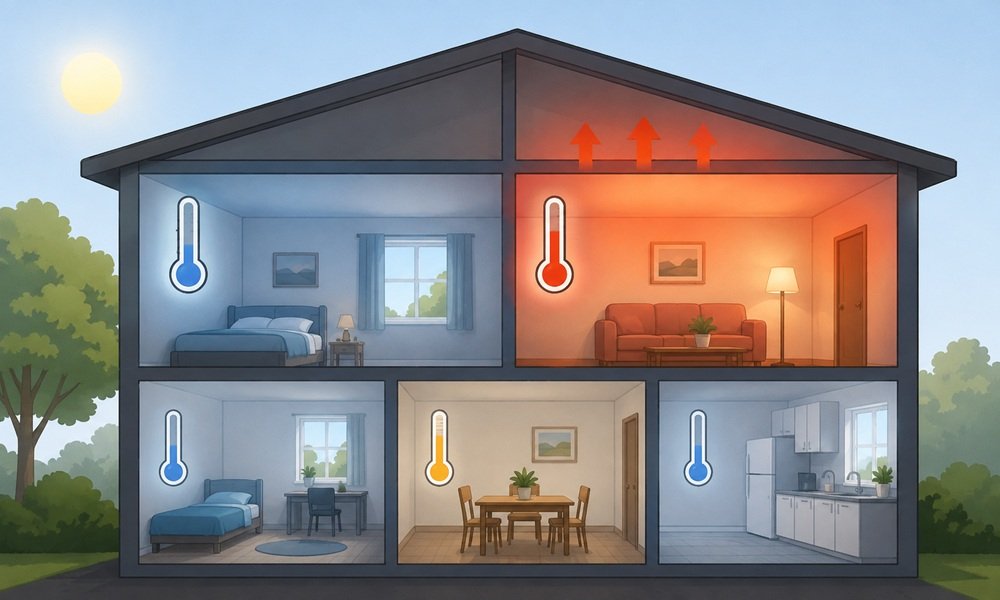
You set the thermostat to a comfortable number. Most of the house feels fine. Then you walk into one room and it feels like a different season.
You are not imagining it. And you are not alone. One room being hotter or colder than the rest is one of the most common home comfort complaints there is.
The good news: the cause is almost always something specific and fixable.
One room is usually a different temperature because conditioned air is not reaching it evenly. The top suspects are duct leaks or blockages, distance from the HVAC unit, poor insulation, direct sun through windows, and a thermostat placed in a room that does not represent that space. A gap of 2 to 3 degrees is normal. A gap of 5 to 10 degrees points to a real problem worth diagnosing.
Why is one room in my house a different temperature than the rest?
Your heating and cooling system was designed to push a set amount of air into each room. When that balance breaks, some rooms win and some rooms lose.
Air can leak out before it arrives. According to ENERGY STAR, the average home loses 20 to 30 percent of the air moving through its ducts to leaks and loose connections. A room at the end of a long, leaky duct run gets whatever is left over.
Heat can also sneak in from outside faster than your system can remove it. A west-facing bedroom taking full afternoon sun has a much bigger heat load than a shaded room next door.
And your thermostat only knows the temperature of the spot it sits in. If it lives in a cool hallway, it shuts the system off while your sunny office is still baking.
What causes a hot or cold room? A quick diagnostic table
Use this to match your symptom to the most likely cause before you spend a rupee or a dollar.
| What you notice | Most likely cause | First thing to try |
|---|---|---|
| Room is worst in the afternoon | Solar heat gain through windows | Blackout blinds or cellular shades |
| Upstairs is hot, downstairs is cool | Stack effect (heat rises) plus thin attic insulation | Run the fan on “on,” add attic insulation |
| Room far from the unit is weak | Long or leaky duct run | Seal and inspect ducts |
| Weak airflow from the vent | Dirty filter, closed damper, or crushed duct | Change filter, open vents, check attic ducts |
| Room over the garage stays hot | Poor insulation on three or more exterior sides | Insulate walls and floor, seal rim joists |
| Whole floor is uneven year round | Undersized or aging system, no zoning | Professional load calculation, consider zoning |
Is it the sun? Solar heat gain explained
Big windows are beautiful. They are also heat magnets.
Sunlight streams through the glass, hits your floor and furniture, and turns the room into a mild greenhouse. Rooms facing east cook in the morning. Rooms facing west cook in the late afternoon.
Your thermostat, sitting somewhere shaded, has no idea this is happening.
Cheap, effective fixes:
- Blackout curtains or cellular (honeycomb) shades on the sunny windows.
- Reflective or low-e window film that cuts heat without blocking the view.
- Exterior shade, like an awning, a pergola, or a well-placed tree.
Is it your ductwork? The most overlooked culprit
Here is a pattern that comes up again and again in r/HVAC and r/HomeImprovement threads: homeowners assume they need a new air conditioner, then a technician crawls into the attic and finds a duct that simply fell off its connector.
Ductwork problems show up as:
- A vent that barely pushes air even on full blast.
- Rooms at the end of the line always struggling.
- A closed or stuck damper choking one branch.
Duct sealing and rebalancing is often cheaper than any equipment upgrade, and it fixes the root cause instead of masking it.
Is it insulation? Why bonus rooms and top floors suffer most
Insulation is what keeps the temperature you paid for inside the room.
The classic problem child is the bonus room over the garage. It has exterior walls on multiple sides, a cold or hot floor above an unconditioned garage, and often the thinnest insulation in the house. It never stands a chance against the main floor.
If you can see the ceiling joists when you look into your attic, you do not have enough insulation up there. Adding blown-in insulation over a problem room is one of the highest-value comfort fixes available.
A test the top articles skip: measure your own delta-T
Most guides tell you the causes. Few tell you how to figure out which one is yours. Here is a simple test.
Buy a cheap probe thermometer or use two identical ones.
- With the system running, measure the air coming out of a supply vent in a good room.
- Measure the air coming out of a supply vent in your problem room.
- Compare.
If both vents blow air at roughly the same temperature but the problem room is still off, your issue is a heat load problem: sun, insulation, or air leaks in that room. Fix the envelope.
If the problem room’s vent blows warmer (in cooling) or weaker air, your issue is a delivery problem: ducts, dampers, filter, or system sizing. Fix the airflow.
That single test tells you which half of this article to focus on.
The vent-closing myth, corrected
Common advice says to close vents in unused rooms to push more air to the room you want. On many modern, tightly sealed duct systems this backfires.
Closing vents raises static pressure inside the ducts. That can force more air out through existing leaks, make the blower work harder, and in some cases reduce total airflow. You end up with a hotter blower and a still-uneven house.
If you have a persistent imbalance, proper damper balancing or zoning solves it far better than guessing with vent covers.
Room-by-room quick fixes
Upstairs bedroom, always hot: Switch the thermostat fan from “auto” to “on” so air keeps circulating between cycles. Add attic insulation. Shade west windows.
Basement, always cold: Basements sit against cool earth. Seal rim joists, add a rug, and consider a small supplemental heater rather than overcooling the whole house.
Home office with electronics, runs warm: Computers and monitors are space heaters. Improve ventilation and keep the door open when possible.
Nursery, needs to be exact: This is the classic case for a small zoning setup or a ductless mini-split, so that one room can be controlled on its own.
When should you call an HVAC professional?
Call a pro when:
- The gap is consistently 5 degrees or more and simple fixes have not helped.
- Airflow from a vent is very weak no matter what you do.
- Your system is over 10 years old and struggles across a whole floor.
- You suspect duct damage in the attic or crawlspace.
Ask specifically about a Manual J load calculation and duct balancing. A good technician diagnoses the cause instead of just selling you a bigger unit.
Frequently asked questions
Is a 3-degree difference between rooms normal?
Yes. A 2 to 3 degree variation across a home is expected and usually not worth worrying about. It is the 5 to 10 degree gaps that signal a real, fixable issue.
Will a bigger air conditioner fix one hot room?
Usually not. If the problem is a duct leak, sun exposure, or bad insulation, a bigger unit just cools the rest of the house faster while the problem room stays off. Fix the actual cause first.
Does home zoning really help?
Yes. Zoning lets different areas be controlled independently with separate dampers and sometimes separate thermostats. It is one of the most reliable long-term fixes for a home that is uneven no matter what you try.
Can a ceiling fan fix an uneven room?
A fan does not change the temperature, but it moves air and makes a warm room feel a few degrees cooler. It is a cheap comfort boost while you tackle the root cause.
Why is my room colder than the rest in winter but the same in summer?
That points to an insulation or air-leak problem on that room’s exterior walls or windows. Heat escapes fastest where the envelope is weakest, and it is most obvious in cold weather.